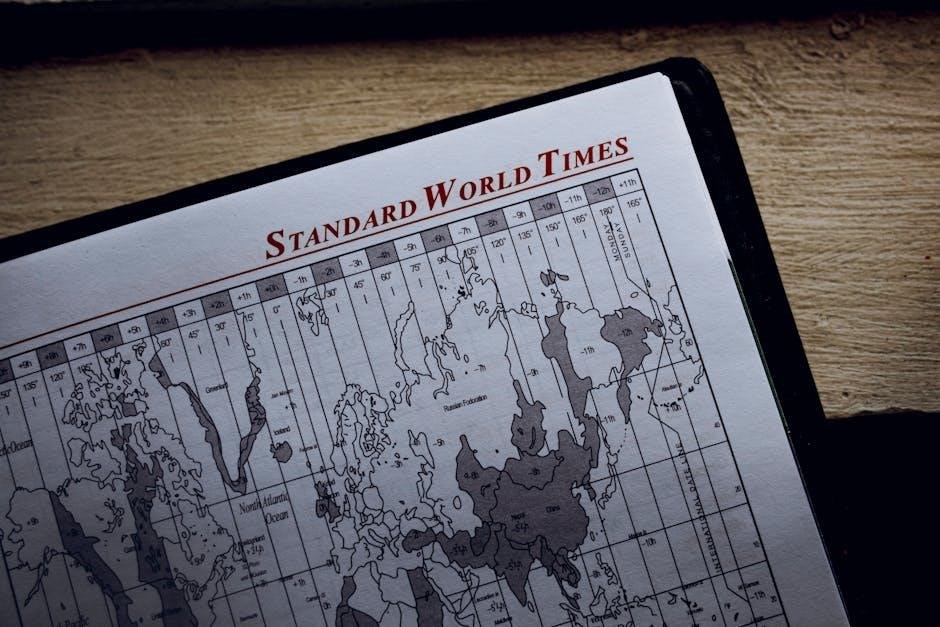
world map with latitude and longitude pdf
World Map with Latitude and Longitude PDF: A Comprehensive Plan
Navigating our world relies on precise location data, readily available through detailed PDF maps displaying latitude and longitude coordinates for global understanding.
Latitude and longitude are the fundamental coordinates used to define any location on Earth’s surface, forming a grid system essential for mapping and navigation. These angular measurements, expressed in degrees, minutes, and seconds, pinpoint positions with remarkable accuracy. Latitude lines, or parallels, run east-west, circling the globe and measuring distance north or south of the Equator. Conversely, longitude lines, or meridians, converge at the poles, running north-south and measuring distance east or west of the Prime Meridian.
Understanding this system is crucial when interpreting world maps, especially those presented in PDF format, as they visually represent this geographic framework. Accurate interpretation allows for precise location identification and distance calculations, vital for various applications from travel planning to scientific research.
What is a World Map with Latitude and Longitude?
A world map with latitude and longitude is a cartographic representation of Earth displaying a grid network of these coordinates. This grid allows for the precise identification of any location globally. Unlike basic political or physical maps, these maps emphasize the angular relationship between points on the Earth’s surface and the center of the planet.
Frequently available as a PDF document, these maps offer portability and ease of use. The PDF format ensures consistent display across different devices. They are invaluable tools for geographers, travelers, and anyone needing to understand spatial relationships and pinpoint locations accurately, facilitating navigation and data analysis.
Why Use a PDF Format for World Maps?
PDF (Portable Document Format) is ideal for world maps because it guarantees consistent rendering across various platforms – Windows, macOS, and mobile devices – preserving the map’s intended appearance. Unlike image formats, PDFs maintain text clarity when zoomed, crucial for reading latitude and longitude coordinates.
Furthermore, PDFs are easily shareable and printable without formatting issues. They often support interactive elements like clickable coordinates or searchable text. The relatively small file size of PDFs compared to high-resolution images makes them convenient for download and storage, offering accessibility and reliability for geographical data.
Understanding Latitude Lines
Latitude lines, also known as parallels, are horizontal imaginary lines encircling the Earth, measuring distance north or south of the Equator. These lines run east to west and are crucial for pinpointing locations on a world map. Their key characteristic is that they maintain a consistent distance from each other, regardless of longitude.
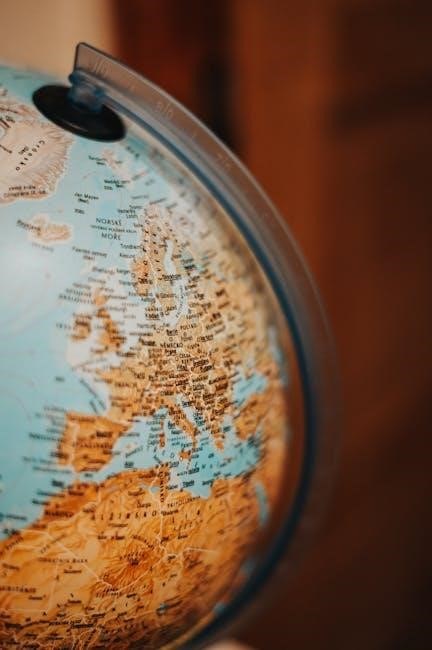
Latitude is measured in degrees, ranging from 0° at the Equator to 90° North at the North Pole and 90° South at the South Pole. Understanding these lines is fundamental when utilizing a world map PDF for navigation or geographical analysis.
Definition and Characteristics of Latitude
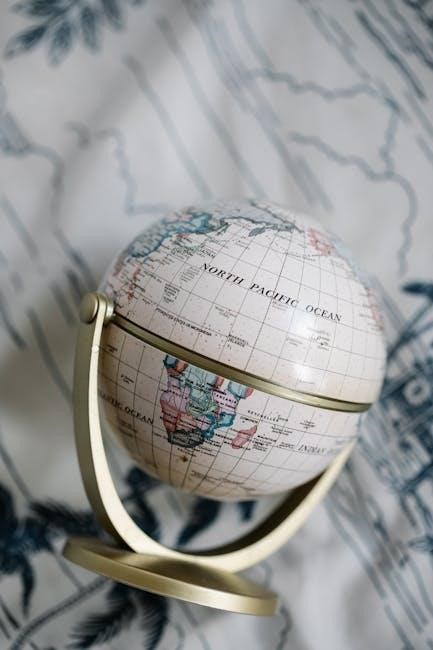
Latitude defines the angular distance, measured in degrees, north or south from the Earth’s Equator. It’s a horizontal coordinate on a map, represented by parallels. A key characteristic is its consistent spacing; each degree of latitude is approximately 69 miles (111 kilometers) apart.
Latitude values range from 0° at the Equator to 90° at both poles. These lines never intersect, forming complete circles around the globe. Utilizing a PDF world map, understanding latitude allows for precise location identification and distance calculations along north-south routes, essential for geographical studies.
Key Latitude Lines: Equator, Tropics, and Circles
Essential latitude lines define climatic zones and geographical regions. The Equator (0°) divides the Earth into Northern and Southern Hemispheres, receiving the most direct sunlight. The Tropics of Cancer (23.5°N) and Capricorn (23.5°S) mark the furthest points where the sun can be directly overhead.
Arctic and Antarctic Circles (66.5°N/S) define regions experiencing 24 hours of daylight or darkness annually. A PDF world map clearly illustrates these lines, aiding in understanding seasonal variations and global climate patterns. These lines are crucial for navigation and geographical analysis, providing a framework for spatial understanding.
Understanding Longitude Lines
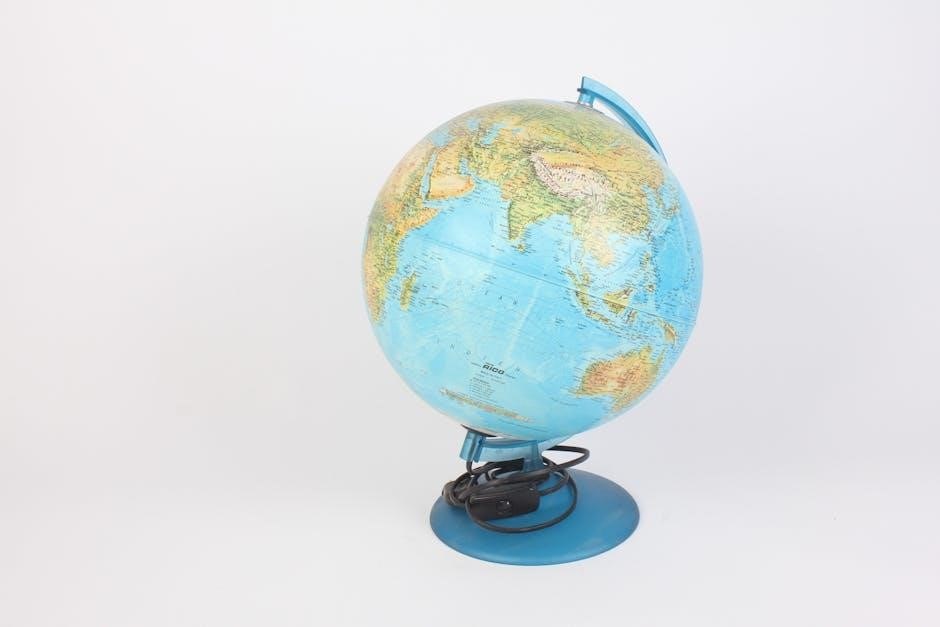
Longitude lines, or meridians, run vertically, converging at the North and South Poles, unlike parallel latitude lines. They measure the angular distance east or west of the Prime Meridian (0°), established in Greenwich, England. Each degree of longitude equates to a varying distance depending on latitude, shrinking towards the poles.
A PDF world map displaying longitude is vital for pinpointing locations accurately. The International Date Line, roughly following the 180° meridian, marks where each day begins. Understanding longitude is crucial for time zone calculations and precise geographical positioning, enhancing map interpretation.
Definition and Characteristics of Longitude
Longitude defines a location’s east-west position on Earth, measured as an angle from the Prime Meridian. Unlike latitude, longitude lines aren’t parallel; they converge at the poles. This convergence means distances represented by each degree of longitude decrease as you move towards higher latitudes.
A PDF map utilizing longitude employs values ranging from 0° to 180° East and West. These lines are often depicted as semi-circles, crucial for accurate geographical referencing. Understanding these characteristics is fundamental when interpreting a world map and determining precise locations using longitude coordinates.
The Prime Meridian and International Date Line
The Prime Meridian, designated as 0° longitude, passes through Greenwich, England, serving as the starting point for measuring longitude east and west. A PDF world map clearly marks this crucial reference line. Opposite the Prime Meridian lies the International Date Line, roughly following the 180° longitude.
Crossing the International Date Line signifies a calendar day change; traveling west adds a day, while traveling east subtracts one. Accurate representation of these lines on a PDF map is vital for time zone calculations and global coordination. These features are essential for interpreting location data on any world map.
How Latitude and Longitude Determine Location
Latitude and longitude form a coordinate system, enabling precise pinpointing of any location on Earth. A PDF world map utilizes this grid to define positions. Latitude, measured north or south of the Equator, ranges from 0° to 90°. Longitude, measured east or west of the Prime Meridian, spans 0° to 180°.
Combining these values – for example, 40°N, 74°W – uniquely identifies a specific point. Understanding this system is crucial when using a PDF map for navigation, research, or simply locating places. Accurate coordinate reading is fundamental to map interpretation.
Types of World Map Projections Affecting Latitude/Longitude Representation
PDF world maps utilize various projections to represent Earth’s curved surface on a flat plane, inevitably distorting latitude and longitude. The Mercator projection, while preserving shape locally, exaggerates areas at higher latitudes. Conversely, the Robinson projection offers a compromise, minimizing distortion across all areas but sacrificing precise shape and angle.
Choosing the right projection within a PDF map depends on the intended use; navigation favors shape preservation, while area comparisons benefit from minimized distortion. Understanding these trade-offs is vital for accurate interpretation of latitude and longitude data.
Mercator Projection: Strengths and Weaknesses
Within a PDF world map, the Mercator projection excels at preserving local shapes and angles, making it invaluable for nautical navigation where maintaining accurate bearings is crucial. However, this comes at a significant cost: substantial area distortion, particularly at higher latitudes. Greenland, for example, appears vastly larger than its actual size relative to Africa.
This distortion arises from attempting to represent a sphere on a flat surface while preserving angles. While widely used historically, modern PDF maps often include disclaimers regarding Mercator’s area inaccuracies, emphasizing its limitations for general geographic comparisons;
Robinson Projection: A Compromise Approach
For PDF world maps aiming for a balanced visual representation, the Robinson projection offers a compelling compromise. Unlike the Mercator projection, it neither preserves all shapes nor areas perfectly, but minimizes distortions across the entire globe. This makes it a popular choice for thematic maps and general reference PDFs where overall accuracy is prioritized over precise local measurements.
While some distortion inevitably exists, it’s distributed in a way that’s less noticeable than in other projections. The Robinson projection provides a more visually harmonious and geographically realistic depiction of Earth, suitable for educational PDF resources and broad overviews.
Finding and Downloading PDF World Maps with Latitude and Longitude
Locating high-quality PDF world maps featuring latitude and longitude is surprisingly accessible. Numerous online resources offer free downloads, including governmental geographic data portals and educational websites. These often provide maps suitable for basic navigational practice or classroom use. However, be mindful of resolution and licensing terms.
For professional applications demanding higher detail, consider paid options. Specialized cartography websites and GIS data providers offer high-resolution PDF maps with enhanced accuracy and features. Scribd and similar platforms also host a variety of maps, though verifying source reliability is crucial.
Reliable Sources for Free PDF Maps
Several reputable sources provide free PDF world maps displaying latitude and longitude. The National Oceanic and Atmospheric Administration (NOAA) offers geomagnetic maps, valuable for understanding magnetic variations. Educational institutions and governmental geographic data portals frequently host downloadable maps suitable for learning and basic navigation.
Websites like Scribd contain user-uploaded maps, but verifying the source’s credibility is essential. Additionally, many open-source GIS projects distribute maps under permissive licenses. Remember to check the map’s projection and scale to ensure it meets your specific needs before utilizing it for any critical application.
Paid Options for High-Resolution Maps
For professional applications demanding superior detail, several vendors offer high-resolution world map PDFs with latitude and longitude grids. Companies specializing in cartography and GIS data provide maps with varying levels of accuracy and feature richness. These often include editable layers and specialized projections.
Purchasing a map ensures quality control and access to customer support. Options range from detailed political maps to topographic maps showcasing elevation data. Consider the intended use – navigation, research, or presentation – when selecting a provider and resolution. Expect to pay more for maps with enhanced features and licensing rights.
Using Latitude and Longitude on a World Map PDF
Digital world map PDFs displaying latitude and longitude empower users to pinpoint exact locations globally. Locating coordinates involves identifying the intersecting lines on the grid; latitude first, then longitude. These maps facilitate precise navigation and spatial analysis, crucial for various disciplines.
Measuring distances requires understanding the scale and the Earth’s curvature. Utilize the map’s scale bar alongside latitude/longitude differences to calculate distances accurately. Specialized software can automate these calculations. Remember that distances are longest when measured across latitude lines and shortest along longitude lines.
Locating Specific Coordinates
Precisely locating coordinates on a world map PDF demands a systematic approach. Begin by identifying the latitude line – its angular distance north or south of the Equator, measured in degrees. Then, find the corresponding longitude line, representing the angular distance east or west of the Prime Meridian, also in degrees.
The intersection of these lines defines the specific location. Pay close attention to the map’s scale and coordinate system. Some maps use decimal degrees, while others employ degrees, minutes, and seconds. Accurate interpretation is vital for pinpointing locations effectively, enabling precise geographic referencing.
Measuring Distances Using Latitude and Longitude
Determining distances using latitude and longitude on a world map PDF requires understanding that one degree of latitude remains relatively constant, approximately 69 miles (111 kilometers). However, one degree of longitude varies significantly with latitude, shrinking as you move towards the poles.
Therefore, direct multiplication isn’t always accurate. Utilize the map’s scale or employ online distance calculators that account for this convergence. For precise measurements, especially over long distances, consider using specialized Geographic Information System (GIS) software. These tools provide accurate distance calculations based on the map projection and coordinate system.
Applications of Latitude and Longitude World Maps
World maps featuring latitude and longitude are invaluable across diverse fields. Navigation and travel planning heavily rely on these coordinates for pinpointing locations and charting routes, whether for maritime, aerial, or terrestrial journeys.
Furthermore, in geographic research and data analysis, these maps facilitate spatial studies, environmental monitoring, and resource management. Researchers use coordinates to track phenomena, analyze patterns, and create predictive models. Accurate location data is also crucial for logistics, emergency response, and global communication networks, underpinning many aspects of modern life.
Navigation and Travel Planning
Latitude and longitude world maps are fundamental tools for effective navigation and travel planning. These maps enable precise location identification, crucial for charting routes for various modes of transport – from ships traversing oceans to airplanes flying across continents, and even for individual road trips.
Travelers can utilize coordinates to pinpoint destinations, calculate distances, and estimate travel times. Emergency services also depend on accurate location data for swift response. The ability to convert addresses into coordinates, and vice versa, streamlines logistical operations and ensures efficient travel experiences globally.
Geographic Research and Data Analysis
World maps featuring latitude and longitude are indispensable for geographic research and data analysis. Researchers utilize these maps to spatially analyze phenomena, such as population distribution, climate patterns, and environmental changes. The coordinate system allows for precise data layering and correlation, revealing valuable insights into Earth’s complex systems.
PDF formats facilitate data sharing and collaboration among scientists. Geographic Information Systems (GIS) often rely on latitude/longitude data for creating detailed spatial models. Analyzing digitized soil maps, geomagnetic data, or historical map representations becomes significantly easier with coordinate-based referencing.
Graphic Scales and Map Accuracy at Different Latitudes
Map accuracy, particularly concerning distance measurements, is intrinsically linked to latitude. Graphic scales on world map PDFs must account for the Earth’s curvature. Scales are most accurate near the Equator, where parallels of latitude are relatively consistent in length. However, as you move towards the poles (30° N/S and 60° N/S), the distance represented by a given scale unit decreases.
Consequently, a scale accurate at the Equator will overestimate distances at higher latitudes. Understanding these distortions is crucial for precise analysis. Maps depicting small-scale features, like Texas, demonstrate visible differences in meridian and parallel spacing, highlighting this effect.
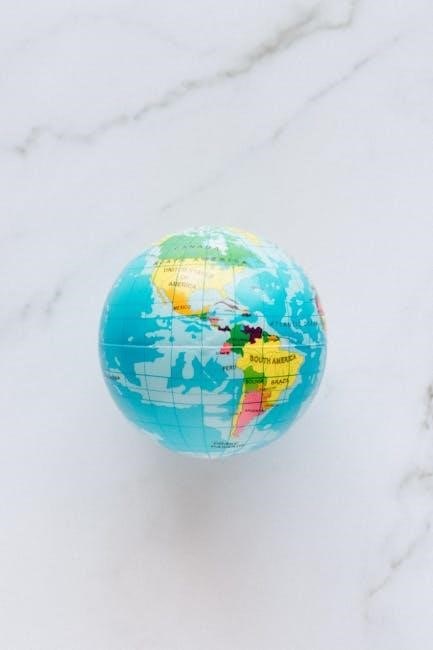
Equatorial Scale Accuracy
At the Equator, a graphic scale on a world map PDF maintains its highest degree of accuracy. This is because parallels of latitude are approximately equal in length along this line, minimizing distortion inherent in map projections. A scale unit, such as one centimeter representing a specific number of kilometers, will reliably reflect ground distance.
Therefore, measurements taken using the graphic scale near the Equator will yield the most precise results. This accuracy diminishes as you move further from the Equator towards the poles, necessitating adjustments or the use of scales specifically calibrated for higher latitudes to avoid overestimation of distances.
30° N/S Latitude Scale Accuracy
Around 30 degrees North or South latitude, the graphic scale on a world map PDF begins to exhibit noticeable, though still manageable, distortion. Parallels of latitude at these degrees are shorter than those at the Equator, meaning a scale unit will represent a smaller ground distance than it would at 0°.
Consequently, measurements taken at 30° N/S require careful consideration. While not drastically inaccurate, distances will be slightly underestimated if the equatorial scale is used directly. Maps often provide specific scales for this latitude band, or users must apply a correction factor for more precise calculations.
60° N/S Latitude Scale Accuracy
At 60 degrees North or South latitude, the distortion of scale on a world map PDF becomes significantly more pronounced; Latitude lines are considerably shorter than at the Equator, resulting in a substantial underestimation of distances if the equatorial scale is applied. A unit of measurement on the map represents a much smaller actual distance on the ground.
Accuracy demands utilizing a scale specifically calibrated for this latitude, or employing a robust correction factor. Maps designed for general use often lack such precision at these higher latitudes, emphasizing the need for specialized maps when accurate measurements are crucial in polar or near-polar regions;
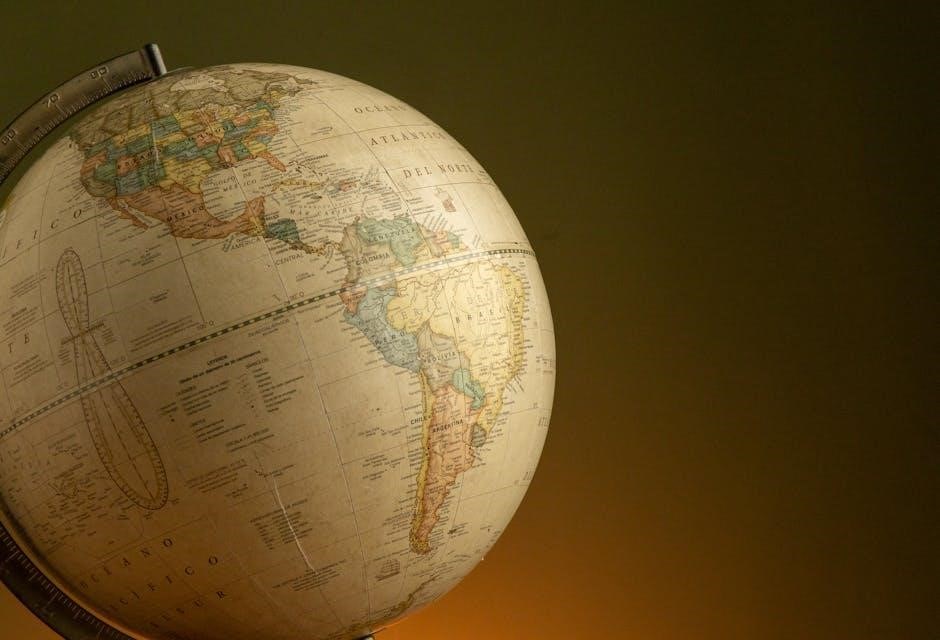
Digitized Soil Maps and Geographic Projections (Latitude-Longitude)
The Digitized Soil Map of the World, scaled at 1:5,000,000, utilizes a Geographic projection – fundamentally based on latitude and longitude coordinates. This system intersects with a template defining water bodies, providing a globally consistent spatial framework. Access to these maps, often available as PDF downloads, facilitates detailed analysis of soil distribution across continents.
Employing latitude-longitude projections ensures accurate spatial referencing, crucial for environmental studies, agricultural planning, and understanding land resource potential. These maps are invaluable tools for researchers and professionals needing precise geographic data, readily accessible in a standardized PDF format.
World Magnetic Model and Geomagnetic Latitude/Longitude Maps
NOAA/NGDC and CIRES collaboratively developed geomagnetic maps utilizing longitude and latitude, specifically the US/UK World Magnetic Model (Epoch 2010.0). These maps, often available as PDF resources, display geomagnetic coordinates – differing from geographic latitude and longitude – and contour intervals of 5 degrees. They are essential for applications requiring accurate magnetic declination information.
Reviewed by NGA/BGS, these maps are vital for navigation systems, surveying, and understanding Earth’s magnetic field. The PDF format allows for easy distribution and integration into Geographic Information Systems (GIS) for advanced spatial analysis and modeling of geomagnetic variations.
Historical World Maps: Latitude and Longitude Representation
Early cartographers progressively incorporated latitude and longitude into world maps, evolving from estimations to precise calculations. Historical maps, often available in PDF format from archives, demonstrate this development. Examples include the “Grande Carte du Monde,” showcasing latitude and longitude grids alongside time zones, political, and physical features.
Analyzing these historical PDFs reveals shifts in map projections and coordinate accuracy over time. They illustrate how understanding of Earth’s shape and magnetic properties influenced mapmaking. These digitized historical maps offer valuable insights into the evolution of geographic knowledge and cartographic techniques.
Leave a Reply
You must be logged in to post a comment.