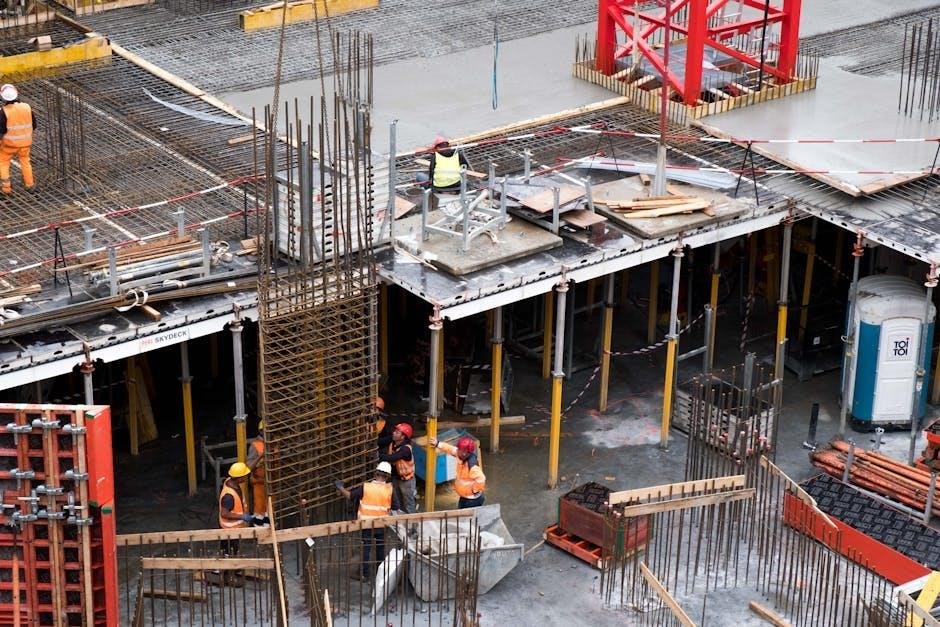
aisc steel construction manual pdf
AISC Steel Construction Manual PDF: A Comprehensive Guide (2026 Edition)
Embark on a journey with the 2026 AISC Manual, a detailed resource for steel construction, offering features, functionality, and troubleshooting guidance for both 6th and 13th editions.
The AISC Steel Construction Manual stands as the definitive resource for structural engineers involved in steel design and construction. This comprehensive guide, available in PDF format, consolidates essential steel design information, adhering to the latest industry standards and best practices. Whether you’re a seasoned professional or a student embarking on your career, understanding this manual is paramount.
The manual serves as a practical application of the AISC Specification for Structural Steel Buildings, offering detailed explanations, design aids, and illustrative examples. It’s designed to streamline the design process, ensuring accuracy and compliance with building codes. Getting started with the manual, particularly the 6th or 13th edition, unlocks a wealth of knowledge, facilitating efficient and reliable steel structure design. It’s a crucial tool for navigating complex projects.
What is the AISC Steel Construction Manual?
The AISC Steel Construction Manual is a compilation of reliable, practical information vital for the design of steel structures. It’s more than just a collection of formulas; it’s a user manual detailing features and functionality for both the 6th and 13th editions, available as a PDF. This resource translates complex specifications into easily applicable design procedures.
It provides engineers with the tools needed to efficiently and accurately design steel buildings and other structures. The manual covers a broad spectrum of topics, from material properties to connection design, offering step-by-step guidance. It’s a crucial document for ensuring structural integrity and code compliance. Understanding its contents is key to successful steel construction projects, offering a streamlined workflow and minimizing potential errors.
Importance of Using the Latest Edition (13th/6th)
Staying current with the AISC Steel Construction Manual – whether the 6th or 13th edition – is paramount for several reasons. Updated editions reflect the latest research, code changes, and industry best practices, ensuring designs are safe, efficient, and compliant. Utilizing older versions risks inaccuracies and potential structural failures, leading to costly revisions or, worse, catastrophic consequences.
The PDF format facilitates easy access and portability, but the information within must be current. Newer editions often incorporate software integration improvements, streamlining workflows with tools like IDEA StatiCa and RAM Structural System. Ignoring updates means missing out on these advancements. Prioritizing the latest edition demonstrates a commitment to professional responsibility and project success, guaranteeing designs meet modern standards.

Understanding the Manual’s Structure
The AISC Manual’s organization is key; chapters are logically arranged, offering a clear path through complex design procedures and specifications for steel construction.
Chapter Organization and Key Sections
The AISC Steel Construction Manual is meticulously organized into chapters, each addressing specific aspects of steel design and construction. Initial chapters delve into fundamental material properties, loading considerations, and the core principles of both Load and Resistance Factor Design (LRFD) and Allowable Strength Design (ASD). Subsequent sections systematically cover the design of structural members – beams, columns, and tension members – detailing procedures for flexure, shear, axial load, and buckling.
Dedicated chapters focus on connection design, encompassing bolted, welded, and other connection types, providing guidance on capacity calculations and detailing requirements. Further sections address specialized topics like stability, fatigue, and fracture control. Appendices offer valuable reference materials, including steel property tables, fastener specifications, and weld symbols. This structured approach ensures engineers can efficiently locate the information needed for any steel design challenge.
How to Navigate the PDF Document
Effectively utilizing the AISC Steel Construction Manual PDF requires understanding its navigational features. The document is comprehensively hyperlinked, allowing direct access to referenced sections, tables, and figures. Leverage the built-in bookmarks panel to quickly jump to specific chapters or topics, bypassing lengthy scrolling. The robust search functionality enables pinpointing information by keyword, equation number, or clause reference.

Familiarize yourself with the PDF reader’s zoom capabilities for detailed examination of tables and diagrams. Utilize the ‘hand’ tool for smooth panning across pages. Regularly updating your PDF reader ensures optimal performance and compatibility. Mastering these techniques transforms the manual from a static document into a dynamic and efficient design tool.
Utilizing Bookmarks and Search Functionality
The AISC Steel Construction Manual PDF’s bookmarks are crucial for efficient navigation. These pre-defined links provide instant access to chapters, sections, and appendices, streamlining your workflow. Customize bookmarks by adding your own for frequently referenced provisions, enhancing personal usability. The search functionality is equally powerful; employ keywords, section numbers, or specific terms to locate relevant content swiftly.
Utilize advanced search operators (e.g;, “AND,” “OR”) for refined results. Remember that the PDF is searchable within tables and figures as well. Regularly updating your PDF reader ensures optimal search performance. Combining bookmarking and searching transforms the manual into a highly responsive and personalized design resource, saving valuable time and effort.

Key Concepts Covered in the Manual
Explore essential steel properties, LRFD and ASD design principles, and detailed specifications within the AISC Manual PDF, guiding robust structural engineering practices.
Steel Material Properties and Specifications
The AISC Steel Construction Manual meticulously details the diverse range of steel grades commonly utilized in modern construction. It provides comprehensive specifications encompassing yield strength (Fy), tensile strength (Fu), and elongation characteristics, crucial for accurate material selection. Furthermore, the manual outlines essential properties like modulus of elasticity, Poisson’s ratio, and shear modulus, enabling precise structural analysis.
Detailed tables categorize various steel types – including carbon steels, high-strength low-alloy steels, and quenched and tempered alloy steels – with corresponding property values. The manual also addresses weldability considerations, chemical composition limits, and impact toughness requirements, ensuring structural integrity and adherence to industry standards. Understanding these specifications is paramount for engineers to confidently design safe and efficient steel structures, leveraging the material’s full potential.

Load and Resistance Factor Design (LRFD) Principles
The AISC Steel Construction Manual thoroughly explains Load and Resistance Factor Design (LRFD), the predominant design philosophy in modern steel construction. LRFD focuses on applying load factors to anticipated loads to account for uncertainties, and resistance factors to material strengths, ensuring a margin of safety. The manual details these factors for various load types – dead, live, wind, snow, and seismic – and resistance categories, like yielding, buckling, and fracture.
It provides clear guidance on calculating design strengths (ΦRn) and required strengths (Ru), forming the core of LRFD calculations. The manual illustrates how to combine load and resistance factors to verify structural adequacy, preventing failures. Understanding LRFD principles, as presented in the manual, is vital for engineers to create robust, reliable, and cost-effective steel structures that meet stringent safety requirements.
Allowable Strength Design (ASD) Principles
While LRFD is dominant, the AISC Steel Construction Manual continues to support Allowable Strength Design (ASD), a traditional design method. ASD focuses on limiting stresses in structural members to allowable stress values, derived by dividing the material’s strength by a factor of safety. The manual meticulously details allowable stress values for various steel grades and loading conditions, offering a conservative approach to design.
It provides comprehensive tables and equations for calculating stresses due to axial loads, bending moments, and shear forces. Engineers utilize these to ensure that actual stresses remain below the established allowable limits. Though less prevalent than LRFD, ASD remains relevant for specific applications and legacy projects. The manual’s clear presentation of ASD principles ensures engineers can confidently apply this method when appropriate, maintaining structural integrity.
Specific Design Procedures & Chapters
Explore detailed chapters on beam, column, and connection design, covering flexure, shear, axial load, bending, bolted, and welded joint procedures within the manual.
Beam Design – Flexure and Shear
The AISC Steel Construction Manual provides comprehensive guidance for beam design, meticulously detailing procedures for both flexure and shear calculations. It outlines methods for determining bending moments and shear forces, crucial for ensuring structural integrity. Users will find detailed explanations of lateral-torsional buckling considerations, a critical aspect of beam stability, alongside provisions for compact, noncompact, and slender sections.
The manual clarifies the application of Load and Resistance Factor Design (LRFD) and Allowable Strength Design (ASD) methodologies to beam design, offering step-by-step examples and practical insights. It covers the selection of appropriate beam sizes, the detailing of shear reinforcement, and the verification of deflection limits. Furthermore, the manual addresses specific scenarios, such as beams with multiple spans and beams subjected to combined loading, providing engineers with the tools to tackle complex design challenges effectively.
Column Design – Axial and Bending
The AISC Steel Construction Manual delivers in-depth coverage of column design, addressing both axial compression and bending moments. It details procedures for calculating column buckling strength, considering various end conditions and bracing configurations. The manual meticulously explains how to determine effective length factors, crucial for accurate buckling analysis, and provides guidance on selecting appropriate column sections to resist combined axial loads and bending.
Engineers will find clear explanations of LRFD and ASD approaches applied to column design, alongside illustrative examples demonstrating practical application. The manual covers local buckling considerations, ensuring sections meet slenderness limits, and provides provisions for columns subjected to eccentric loads. It also addresses the design of built-up columns and the effects of residual stresses, offering a complete resource for robust and reliable column designs.

Connection Design – Bolted and Welded
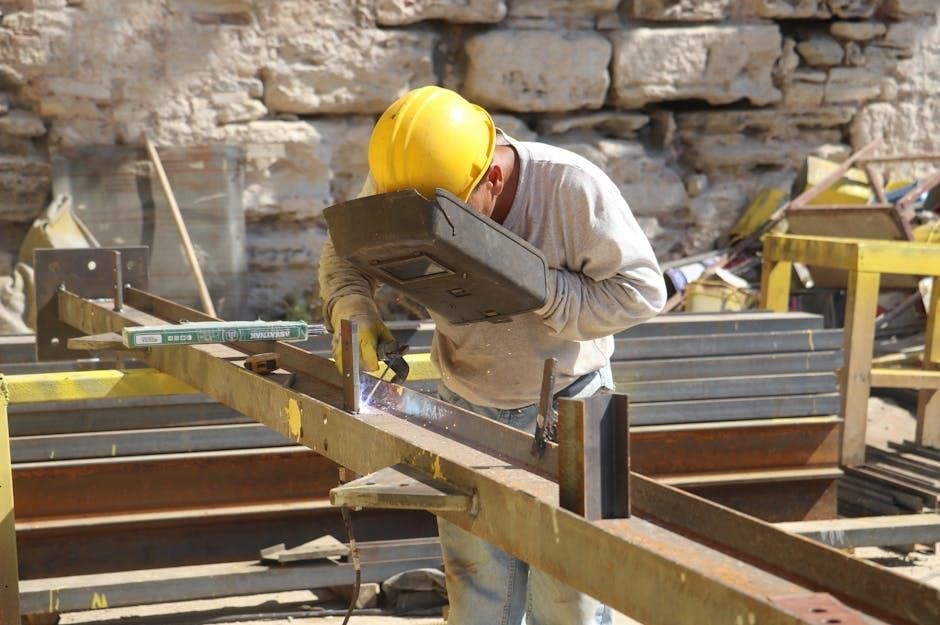
The AISC Steel Construction Manual provides comprehensive guidance on designing both bolted and welded connections, essential components in steel structures. It details procedures for calculating the strength of various connection types, including slip-critical and bearing connections using bolts, and fillet and groove welds. The manual meticulously outlines requirements for bolt hole sizes, edge distances, and weld sizes to ensure adequate strength and prevent failure.
Engineers will find detailed provisions for shear and tension connections, along with guidance on designing connections subjected to combined loading. The manual covers block shear rupture, bolt shear, and weld rupture calculations, offering a complete understanding of connection behavior. It also addresses connection detailing requirements, ensuring proper fabrication and installation, and provides examples illustrating practical application of the design procedures.

Using the Manual for Practical Applications
Apply the AISC Manual’s insights to real-world projects, leveraging step-by-step examples and integrating seamlessly with structural engineering software like IDEA StatiCa.
Step-by-Step Design Examples
The AISC Steel Construction Manual excels in providing practical, illustrative design examples. These aren’t merely theoretical exercises; they demonstrate the application of complex specifications to tangible structural scenarios. Users will find detailed walkthroughs covering common design challenges, such as beam flexure calculations, column stability assessments, and connection detailing for both bolted and welded joints.
Each example meticulously outlines the problem statement, relevant code provisions (LRFD and ASD), step-by-step calculations, and clear presentation of results. These examples serve as invaluable learning tools, enabling engineers to grasp the nuances of steel design and confidently apply the manual’s guidance to their own projects. The manual’s approach fosters a deeper understanding beyond simply plugging numbers into formulas, promoting sound engineering judgment.
Applying the Manual to Real-World Projects
Transitioning from theoretical understanding to practical application is seamless with the AISC Steel Construction Manual. It equips engineers to tackle diverse project demands, from straightforward building frames to complex industrial structures. The manual’s comprehensive coverage ensures all necessary design data and procedures are readily available, streamlining the workflow and minimizing potential errors.
Successfully integrating the manual involves a systematic approach: defining project scope, identifying applicable load combinations, selecting appropriate steel sections, and meticulously verifying designs against code requirements. Furthermore, the manual’s principles are readily adaptable to various software platforms like IDEA StatiCa and RAM Structural System, enhancing efficiency and accuracy in complex analyses. This integration allows for robust and reliable structural designs.
Software Integration with AISC Specifications (e.g., IDEA StatiCa, RAM Structural System)
Modern structural engineering heavily relies on software, and the AISC Manual seamlessly integrates with leading platforms. Programs like IDEA StatiCa and RAM Structural System are designed to directly implement AISC specifications, automating complex calculations and ensuring code compliance. This integration minimizes manual input, reducing the risk of errors and accelerating the design process.
Effective software utilization requires understanding how these tools interpret and apply AISC provisions. Users can leverage the manual to verify software outputs, validate assumptions, and gain deeper insights into the underlying design principles. This synergy between manual knowledge and software capabilities empowers engineers to create optimized, safe, and efficient steel structures, streamlining workflows and enhancing project outcomes.
Troubleshooting and Common Issues
Decoding errors, addressing calculation discrepancies, and clarifying complex rules are crucial when using the AISC Manual PDF for successful steel design applications.
Decoding Error Messages and Warnings
Navigating the AISC Steel Construction Manual PDF often involves encountering error messages or warnings during design checks. These aren’t necessarily indicative of a fundamental flaw, but rather signals requiring careful investigation. Understanding the specific code within the manual is paramount; each message corresponds to a defined rule or limitation.
Common issues stem from incorrect input data, such as mismatched material properties or improperly defined loading conditions. The manual’s commentary sections frequently provide clarification on the rationale behind specific checks, aiding in diagnosis. Furthermore, cross-referencing the error message with the relevant chapter and section within the PDF can pinpoint the source of the problem.
Don’t dismiss warnings lightly; they often highlight potential inefficiencies or areas where a more refined design approach could be beneficial. Thoroughly reviewing the associated commentary and recalculating with adjusted parameters can resolve these issues and ensure a safe, optimized steel structure.
Addressing Discrepancies in Calculations
Discrepancies between hand calculations and results obtained using the AISC Steel Construction Manual PDF are inevitable, demanding a systematic approach to resolution. First, meticulously verify all input data – material properties, dimensions, loads – ensuring consistency between your calculations and the manual’s parameters.
Next, carefully review the applicable equations and formulas within the manual, paying close attention to units and assumptions. Often, subtle differences in interpretation or application can lead to variations. Scrutinize intermediate calculation steps, identifying where the divergence originates.
The manual’s detailed commentary sections can provide valuable insight into the intended application of formulas. If discrepancies persist, consider utilizing structural analysis software alongside the manual to independently verify results. A thorough, step-by-step comparison will pinpoint the source of the error.
Finding Clarification on Complex Design Rules
Navigating the intricacies of steel design often necessitates seeking clarification on complex rules within the AISC Steel Construction Manual PDF. Begin by thoroughly reviewing the manual’s commentary sections accompanying the relevant provisions; these offer detailed explanations and rationale behind the design requirements.
The AISC website provides a wealth of supplementary resources, including frequently asked questions (FAQs), technical bulletins, and design guides addressing common challenges. Utilize the manual’s search functionality to locate specific keywords or clause numbers related to your query.
If further assistance is needed, consider participating in AISC webinars or workshops, or directly contacting AISC for technical support. Remember to clearly articulate your question and provide relevant context for a prompt and accurate response.
Resources and Support
Access the AISC website for online resources, explore certification programs to enhance expertise, and directly contact AISC for dedicated technical assistance when needed.
AISC Website and Online Resources
The American Institute of Steel Construction (AISC) website serves as a central hub for a wealth of supplementary materials related to the Steel Construction Manual. Users can find frequently updated resources, including errata sheets addressing any identified corrections or clarifications within the manual itself.
Furthermore, the AISC offers a comprehensive library of design guides, technical bulletins, and educational seminars – many available for free download or on-demand viewing. These resources delve deeper into specific design topics, providing practical applications and detailed explanations beyond the scope of the manual.
Interactive tools, such as the Steel Construction Calculator, assist with complex calculations, streamlining the design process. The website also features a robust search function, enabling quick access to relevant information and specifications. Regularly checking the AISC website ensures access to the most current interpretations and best practices in steel design.
AISC Certification Programs
AISC offers several robust certification programs designed to validate a professional’s competence in steel building design and fabrication, complementing the knowledge gained from utilizing the Steel Construction Manual. These programs demonstrate a commitment to quality and adherence to industry best practices.
The Professional Engineer (PE) certification, specifically tailored for structural engineers, assesses understanding of AISC specifications and design methodologies. Similarly, the Certified Fabricator program signifies a fabrication facility’s adherence to stringent quality control standards, ensuring reliable steel component production.
Further options include certifications for steel detailers and erectors, covering crucial aspects of the construction process. Participating in these programs not only enhances professional credibility but also fosters a deeper understanding of the manual’s principles, leading to safer and more efficient steel structures.
Contacting AISC for Technical Support
When navigating the complexities of the AISC Steel Construction Manual PDF, direct technical support is readily available to address specific questions and clarify challenging design scenarios. AISC provides multiple avenues for assistance, ensuring professionals can confidently apply the manual’s guidance.
Users can access comprehensive support through the official AISC website, featuring a detailed FAQ section and a searchable knowledge base. For more individualized assistance, a dedicated technical hotline staffed by experienced engineers is available during business hours.
Furthermore, AISC encourages submitting formal technical inquiries through their online portal, guaranteeing a thorough and documented response. This commitment to support ensures the manual remains a practical and reliable resource for all steel construction professionals.
Leave a Reply
You must be logged in to post a comment.